




Best Practices for Building Scalable Business Applications in 2026
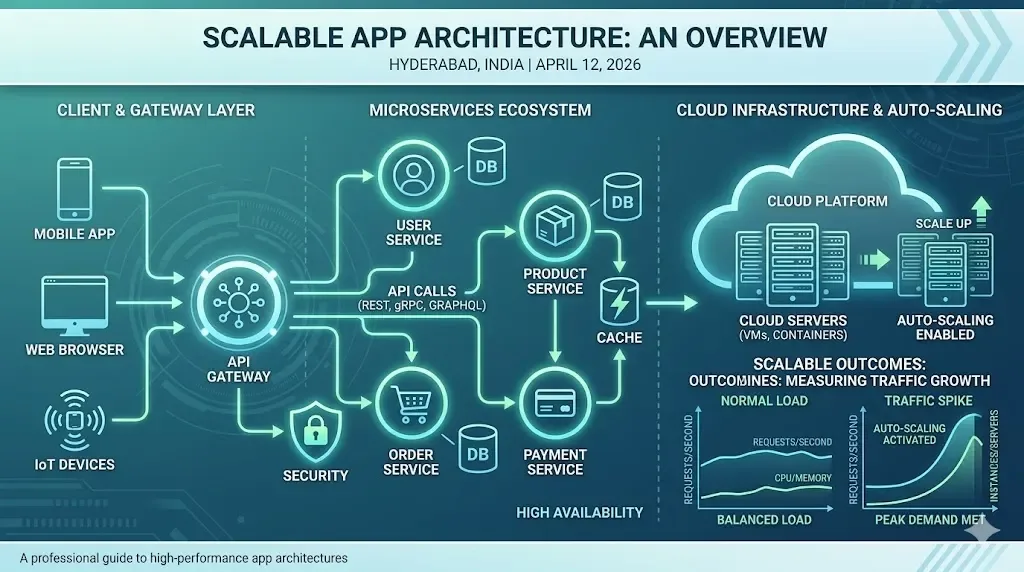
Scalable business applications handle growth in users, data, and features without performance drops or high costs. As companies expand, poor scalability leads to crashes, slow responses, and lost revenue. Following proven best practices ensures your apps support 10x growth seamlessly.
In 2026, cloud-native designs, AI optimization, and microservices dominate. These practices reduce complexity and future-proof investments.
Adopt Microservices and Modular Architecture
Break monolithic apps into independent microservices—small services handling specific functions like payments or user auth. This allows scaling only busy parts, improving resilience and deployment speed.
Use API gateways for communication and containers (Docker) with orchestration (Kubernetes) for management. Benefits include fault isolation and easier updates without full redeploys.
Leverage Cloud-Native Infrastructure
Build on AWS, Azure, or GCP for auto-scaling, load balancing, and serverless options. These handle traffic spikes automatically, cutting infrastructure costs by 30-50%.
Implement horizontal scaling (add servers) over vertical (upgrade one). Enable CI/CD pipelines with GitHub Actions or Jenkins for rapid iterations.
Optimize Database and Data Management
Choose scalable databases: NoSQL (MongoDB) for unstructured data, SQL (PostgreSQL) with sharding for relational. Use caching (Redis) to reduce queries and CDNs for static assets.
Design for read/write separation and eventual consistency in high-load scenarios. Monitor with tools like Prometheus for bottlenecks.
Implement Robust Security and Monitoring
Embed security from start: Zero-trust models, API rate limiting, encryption. Use observability tools (ELK stack, Datadog) for real-time metrics on CPU, latency, errors.
Set alerts for 99.9% uptime. Regular audits prevent breaches that halt scaling.
Frontend and Backend Optimization
Backend: Asynchronous processing (Node.js event loops), efficient algorithms. Frontend: Lazy loading, responsive design, PWAs for mobile scale.
Offload tasks to queues (RabbitMQ) for non-critical jobs.
Key Best Practices Comparison
- Microservices: Scale independently; complex management.
- Monolith: Simple start; hard to scale large.
- Serverless: Pay-per-use; vendor lock-in risk.
- Cloud-Native: Auto-scale; learning curve.
How Starmeda Builds Scalable Apps
Starmeda Solutions Private Limited applies these practices in IT services for web, desktop, mobile with AI integration. Our apps scale effortlessly.
- Spark Venture Studio: Powers 250 apps, 250 games, 100 AI agents with microservices and cloud scaling.
- Xenreach Ad Network: Handles high-traffic ads across ecosystems.
- Flowmeda Modular SaaS ERP: Assemble scalable modules in minutes—no monolith bloat.
- Full Stack Marketing: Optimizes apps for user acquisition at scale.
We deliver Hyderabad-optimized, production-ready scalable apps.
Implementation Checklist
- Design modular from day 1.
- Test load early (JMeter).
- Automate deployments.
- Monitor continuously.
- Plan for 3-5x growth upfront.
Master these for apps that grow with your business!
