




How API Integrations Reduce Business Complexity in 2026
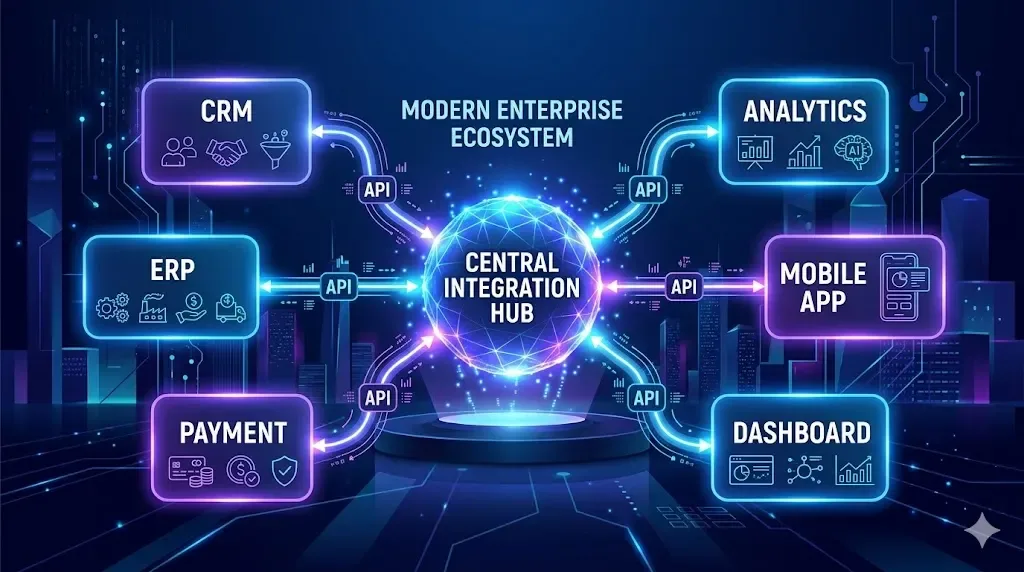
Businesses today use many tools at once: CRM, ERP, payment gateways, analytics platforms, support desks, marketing software, and mobile apps. The problem is not the number of tools alone; the real problem is the disconnected flow of data between them. API integrations solve this by allowing systems to communicate automatically, which reduces manual work, lowers errors, and makes operations much easier to manage.
API stands for Application Programming Interface, and in simple terms, it acts like a bridge between different software systems. Instead of teams copying data from one platform to another, APIs let the systems share information in real time. This means faster decisions, better customer experiences, and fewer bottlenecks in daily operations.
Why API integrations matter
API integrations help businesses remove complexity in a practical way. They connect systems that would otherwise operate separately, so data moves smoothly across departments and processes. This creates a single connected workflow instead of multiple disconnected steps.
The biggest advantages include:
- Less manual data entry.
- Faster communication between software tools.
- Better accuracy in reports and records.
- Improved customer service through real-time updates.
- Easier scaling when the business grows.
- Lower operational cost because teams spend less time on repetitive tasks.
When businesses grow, complexity usually grows too. New software tools are added, new departments need access to data, and customer expectations increase. Without proper integrations, teams end up using spreadsheets, duplicate records, and manual follow-ups. APIs reduce that chaos by making systems work together.
Common business problems APIs solve
Many organizations face the same challenges as they expand. Sales teams may use one CRM, finance may use another billing system, and support may use a separate ticketing platform. Without integration, each team works with partial information.
APIs help solve problems such as:
- Duplicate customer records.
- Delayed order processing.
- Manual invoice generation.
- Poor coordination between sales and support.
- Inconsistent data across platforms.
- Slow reporting and decision-making.
For example, when a customer places an order on a website, an API can instantly send the order to inventory, accounting, shipping, and customer support systems. This removes the need for teams to manually update each system one by one.
How APIs simplify operations
API integrations simplify business operations by creating automation across workflows. Instead of asking employees to move data between tools, the business creates rules once and lets the systems handle the rest.
A few practical ways APIs help are:
- Connecting websites to payment gateways for instant transactions.
- Syncing leads from forms into CRM systems automatically.
- Sending invoice data directly into accounting software.
- Updating stock levels across sales and warehouse systems.
- Linking support tools with customer history data.
- Pulling analytics from multiple systems into one dashboard.
This kind of automation saves time and also improves reliability. When systems communicate directly, there is less chance of missing information or human error.
API integrations and business growth
API integrations are not only about convenience. They also support growth by making it easier to launch new products, enter new markets, and add new services without rebuilding everything from scratch. A business with a well-connected digital ecosystem can move much faster than one relying on isolated software tools.
This is especially important for companies planning mobile apps, SaaS products, AI tools, or multi-channel customer journeys. APIs make it possible to reuse existing systems and connect them to new platforms quickly. That reduces development time and keeps the business more flexible.
How Starmeda helps
Starmeda Solutions Private Limited helps businesses reduce complexity through custom IT services, including web, desktop, and mobile app development with AI integration. We build software systems that can connect smoothly with third-party tools, internal platforms, and business workflows.
Our Spark Venture Studio is designed to publish 250 mobile apps, 250 mobile games, and 100 AI agents, which naturally requires strong integration architecture and scalable digital systems. That same expertise helps us build connected software environments for clients who want automation and growth.
Flowmeda, our modular SaaS ERP solution, is a strong example of API-driven flexibility. Businesses can choose the modules they need and build an application within minutes, without unnecessary complexity. Xenreach, our ad network, also benefits from integration across the app ecosystem, allowing monetization and performance tracking to work efficiently. Through full stack marketing, we also connect business systems with campaign tools so data flows into action faster.
Why this matters now
In 2026, businesses compete on speed, automation, and customer experience. Companies that still depend on disconnected tools will spend more time fixing problems than growing. API integrations make software ecosystems simpler, cleaner, and easier to scale.
They do not just connect apps. They connect teams, data, and processes into one efficient system. That is why API integrations are one of the most practical ways to reduce business complexity today.
