

Custom ERP Dashboard for Multi-Location Manufacturing Operations
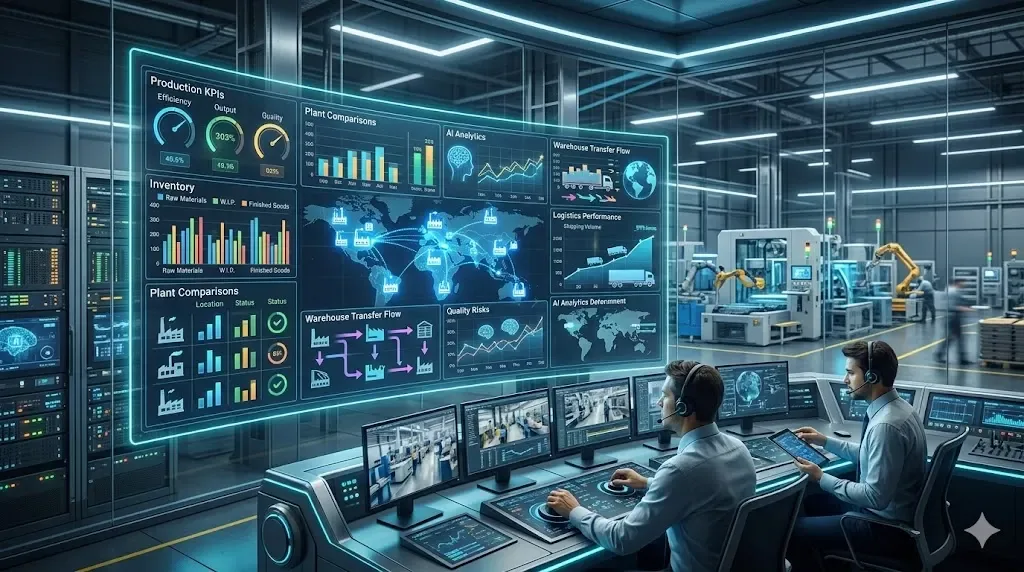
Managing multiple manufacturing units is complex when production data, inventory status, procurement activity, dispatch updates, and finance records are spread across disconnected systems. A custom ERP dashboard for multi-location manufacturing operations gives business leaders one centralized control center to monitor plant performance, compare site-level KPIs, streamline coordination, and make faster decisions with real-time visibility across locations.
For manufacturers operating across factories, warehouses, contract units, or regional production centers, the biggest challenge is not just data collection but turning distributed operational data into actionable intelligence. Modern manufacturing ERP dashboards are designed to unify production, inventory, orders, logistics, and financial information into a single system so every stakeholder works with the same live data instead of relying on fragmented spreadsheets and delayed reporting.
Why Multi-Location Manufacturers Need a Custom ERP Dashboard
As businesses expand to multiple facilities, operational complexity grows rapidly. Each location may have different production capacities, stock levels, staffing conditions, maintenance schedules, procurement cycles, and dispatch timelines. Without centralized visibility, management teams struggle to balance workloads, prevent stockouts, reduce idle time, and standardize processes across sites.
A custom ERP dashboard solves this by consolidating operational data into one interface where leaders can track branch-wise and plant-wise performance in real time. Centralized dashboards help decision-makers monitor inventory across locations, view sales and production trends, identify operational issues quickly, and reduce redundant manual administration.
Core Features of a Multi-Location Manufacturing ERP Dashboard
A high-performing ERP dashboard for manufacturing operations should go beyond static reporting. It should provide role-based, interactive insights that help management, operations teams, procurement staff, and plant heads act immediately based on live operational metrics.
- Centralized multi-site visibility: View production, inventory, orders, and financial data from all plants and warehouses through a single dashboard.
- Real-time inventory tracking: Track stock availability, inter-branch transfers, batch status, and replenishment needs across locations to reduce overstocking and stockouts.
- Production planning and scheduling: Allocate resources effectively, balance workloads between sites, and optimize production workflows to reduce lead times and idle capacity.
- Logistics and dispatch coordination: Identify the best warehouse or production site for order fulfillment based on stock, location, time, and cost variables.
- Custom widgets and drill-down reports: Use dashboards with charts, alerts, graphs, and drill-down access to source records for deeper analysis.
- Role-based dashboards: Give each user personalized views based on responsibilities such as production, inventory, QA, finance, or leadership oversight.
- Cloud access across facilities: Enable management teams to review performance and collaborate across branches without being physically present at each site.
Business Benefits
When all facilities operate on a unified ERP dashboard, manufacturers gain a more accurate view of enterprise performance and can respond faster to changes in demand, production delays, inventory imbalances, and operational bottlenecks. Centralized control improves consistency, data accuracy, and decision speed while reducing dependence on manual reconciliation between branches.
Real-time synchronization also supports better inventory allocation and demand planning. When one facility updates stock or fulfills an order, the ERP can immediately reflect changes across all connected locations, which helps avoid duplicate orders, excess inventory, and delayed fulfillment.
Custom dashboards also strengthen reporting maturity. Manufacturers can monitor KPIs such as plant efficiency, machine utilization, order status, production output, defect rates, procurement cycles, warehouse movement, and branch-wise profitability in one place, making it easier to identify weak areas and improve operational efficiency.
How Starmeda Solutions Helps
Starmeda Solutions Private Limited helps manufacturing businesses build custom ERP dashboards tailored to multi-location operations, not generic one-size-fits-all software. Through its IT services expertise in web, desktop, and mobile app development, Starmeda can design and develop centralized dashboard systems that unify factory data, warehouse workflows, branch reports, and management insights into a single digital command center.
With AI integration capabilities, Starmeda can also enhance manufacturing dashboards with intelligent alerts, forecasting support, anomaly detection, demand analysis, and automated workflow recommendations so decision-makers can move from reactive management to predictive operations.
For businesses looking for flexibility, Starmeda’s Flowmeda modular SaaS ERP approach is especially relevant. Manufacturers can choose the modules they need, such as inventory, procurement, production, dispatch, finance, HR, or reporting, and build a solution that fits their operational structure instead of paying for unnecessary complexity. This modular approach is well suited for growing manufacturing groups that want to digitize multiple locations in phases while maintaining centralized oversight.
Ideal Use Cases
- Manufacturers operating multiple factories in different cities or states.
- Businesses managing multiple warehouses and regional distribution points.
- Production companies needing centralized oversight of stock transfers and order fulfillment.
- Growing manufacturing groups looking to standardize reporting and workflows across locations.
- Operations teams that need live dashboards for production, scheduling, QA, procurement, and dispatch.
Conclusion
A custom ERP dashboard for multi-location manufacturing operations gives manufacturers the control, visibility, and scalability needed to run distributed operations efficiently. By combining centralized data, real-time monitoring, modular ERP architecture, and AI-driven insights, Starmeda Solutions can help manufacturing businesses build a smarter and more connected operational ecosystem that supports growth across every location.
